


Khoresht Gheymeh Nesar #EattheWorld

This month the Eat the World bloggers are turning their focus on Iran. Read more about the Eat the World project here. And click here to see One Hundred Months of #EattheWorld.
The Other Posts
Ash Reshteh by Pandemonium Noshery
Keto Khoresh Bamieh With Beef Mince by Sneha's Recipe
Khoresht Gheymeh Nesar by Culinary Cam (you're here)
Sālād-é-Shirāzi by A Day in the Life on the Farm
Sohan-e Qom (Saffron Brittle) by Amy's Cooking Adventures
Iran Through Various Memoirs
Apparently I have been drawn to reading memoirs from Iran over the the years. It might be because I had good friend when I lived in Berkeley who had fled Iran with her sister. Most of her family was still there.
Pomegranate Soup by Marsha Mehran
Mehran transports the reader to the fictional village of Ballinacroagh in western Ireland in 1986. After fleeing Iran during the revolution of 1979, Marjan, Bahar, and Layla - the three Aminpour sisters - are working feverishly to open their new café, the Babylon Café. They are intent on setting down roots and building a new life away from their turbulent homeland. Each chapter begins with a recipe and, through Marjan's cooking, we learn about the sisters' experiences in Iran through flashbacks related to the foods. Though Mehran doesn't shy away from the traumas that can occur during political upheaval, she achieves a delicate balance of reality and sensitivity. It's quite a remarkable book that has me longing to read more about the Iranian revolution.
The Temporary Bride: A Memoir of Love and Food in Iran by Jennifer Klinec
This is Jennifer Klinec's memoir of her finding food - and love - in Iran. Klinec grew up in Canada, born to a Hungarian father and a Yugoslavian mother. Her 20s had her climbing the corporate ladder before she abandoned it all to teach cooking classes out of her flat in London. Then, in her 30s, she heads to Iran to learn authentic recipes and meets Vahid, a younger Iranian man who introduces Klinec to his mother who begins teaching her to cook. As you can guess, Klinec and Vahid embark on a clandestine affair until they get a Mullah to grant them a 'temporary marriage' which is a socially acceptable way for them to carry on a relationship. Though that acceptance does not apply to his family and Klinec finds herself being shunned by his mother where, when she was just an eager cooking student, she was previously embraced.
Funny in Farsi: A Memoir of Growing Up Iranian in America by Firoozeh Dumas
Funny in Farsi is a memoir written by an Iranian-born author who immigrated to California when she was 7 years old. It's - as you would expect from the title - funny. Really funny. But it's also heart-wrenching and mortifying.
Imagine having your name's pronunciation slaughtered at every turn. I didn't have to imagine; I get it all the time. Most of the time I just introduce myself this way: "It's Camilla. Like Pamela, but with a C." Still, when people see if, even after I have just said it, it's still Ca-MI-la or Camellia, like those horrible flowers that rot while they are still on the bush. She writes My name, Firoozeh, chosen by my mother, means 'Turquoise' in Persian. In America, it means 'Unpronounceable'.... One mom at her children's school refused to learn her name and, instead, started calling her 'F-Word.'
Dumas writes with candor and her accounts truly convey the immigrant experience. I, myself, am first generation, but I have heard stories from my parents and my grandparents. So, I can relate by extension.
I chuckled at her characterization of Berkeley. Having lived there for 5 years for college, I would agree with her assessment - Berkeley wasn't just any armpit, it was an armpit in need of a shave and a shower, an armpit full of well-read people.... Don't get me wrong, I love Berkeley. But her characterization is painfully accurate. I think that's where her humor succeeds: She tells it like it is.
Persepolis by Marjane Satrapi
Persepolis is the story of Marjane's childhood in Iran during the Islamic Revolution. While I think it's an important topic and will lead to some, hopefully, productive discussions in the literature class, I didn't care for the book. I felt that reading the story in graphic novel format was a little like reading bullet points. The narrative is necessarily restricted to one sentence per panel or frame. I wanted more - more description, more depth of character, just more. But I was saddened to read of her recent death.
I have likely read some others. But these are the first ones that come to mind.
May It Nourish Your Soul
Not being a Farsi speaker, I can only hope that my reading and research is accurate. But I love the sentiment of this, if it is correct: "May it nourish your soul."
نوش جانت
/ nush-e jânat /
interjection / set phrase · bon appétit; enjoy your meal (lit. 'may it nourish your soul')
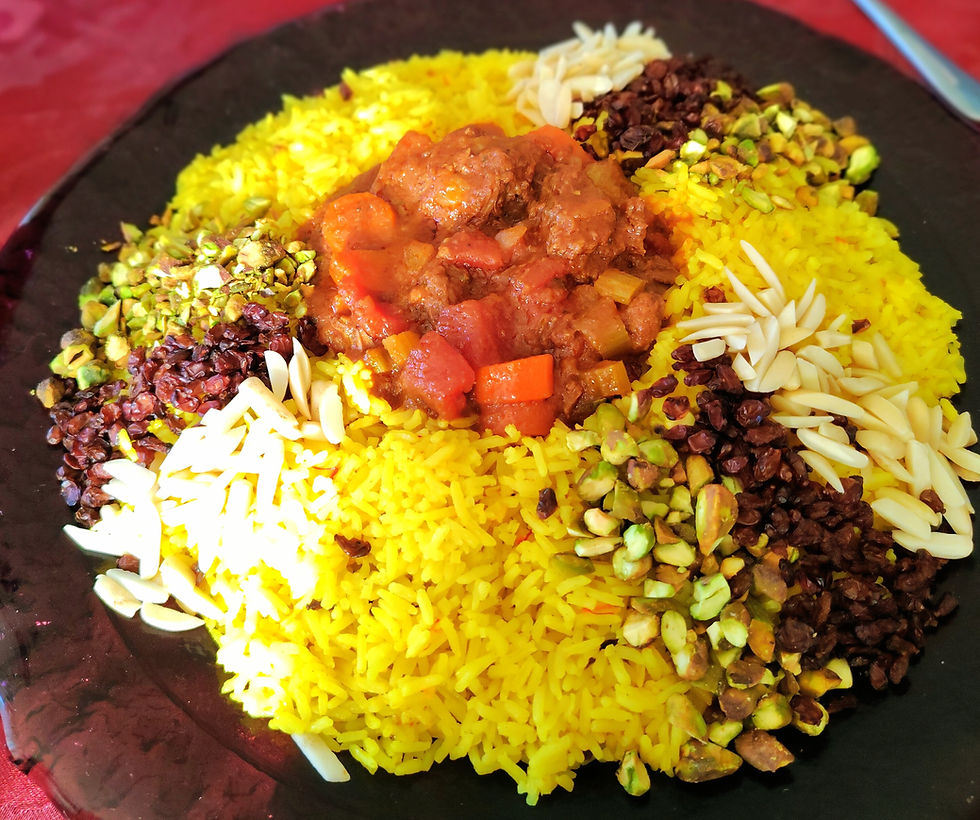
Khoresht Gheymeh Nesar
I didn't know what this dish was until I was researching recipes and kept seeing beautiful photos of a colorful, composed rice dish. And I came across this name. I had to try it!
Lamb Stew
Ingredients
1 pound stew lamb, trimmed of most of the fat and cubed
1/2 pound stew beef, trimmed of most of the fat and cubed
3 Tablespoons oil
1 onion, peeled and chopped, approximately 1 cup
3 cloves garlic, minced
1 cup tomato sauce
1 cinnamon stick
4 cups beef broth (I had some homemade beef bone broth)
1/2 teaspoon salt
1/4 teaspoon ground cloves
1/4 teaspoon ground allspice
1/2 teaspoon ground black pepper
1/4 teaspoon ground cardamom
The Rest of the Dish
basmati rice cooked with saffron and turmeric
barberries
sliced almonds
chopped pistachios
Procedure
Heat the oil in a heavy-bottomed pot with a lid. Add the meat, in batches, and cook until browned on all sides. Remove the meat from the pot and add the onions. Cook for a minute and stir to coat with all the juices from the meat. Reduce the heat to medium low and cook, stirring, until caramelized, approximately 15 to 20 minutes.
Turn the heat to medium high and add the garlic to the pan, cook for a minute before adding in the tomato sauce, cinnamon stick, beef broth, browned meat, salt, cloves, allspice, black pepper, and cardamom to the pot..
Bring to a simmer, then cover and reduce the heat to low. Braise for 2 hours, until the meat is tender. The sauce should also be nicely thickened. If it is still too liquidy, remove the lid and bring to a boil until reduced to desired thickness.
To assemble, stir the barberries into your rice and spoon out onto a platter. There were so many different designs of this dish. I decided to make a hollow in the rice and fill it with the lamb stew. Then I garnished the rice with sliced almonds and chopped pistachios. It was colorful and delicious. We will definitely be making this again.
Other Iranian Dishes
I have shared a few other dishes that I wanted to point my readers to: Sabzi Khordan (Fresh Herb Platter), Omlet-e Gojeh Farangi, and Tacheen...
...Kabob Koobideh, Aash-e Reshte, and Gheysavah.
That's a wrap for my Iranian offering for #EattheWorld. We will be back next month with another tabletop travel adventure. Stay tuned!


Comments